How is Spousal Support Calculated in California?
California uses a guideline formula based on both spouses' net incomes to calculate spousal support. Here's how DissoMaster works, what factors matter, and what long marriages mean for your award.
By IncoVoid Editorial Team
If you're divorcing in California, spousal support (sometimes called alimony or "gavage" in older legal texts) is one of the most significant financial questions you'll face. California has a well-defined guideline formula, but it's more complex than most states because it runs through specialized software. Here's what you need to know.
What California Calls It
California uses two distinct terms depending on where you are in the process:
Temporary spousal support is paid while the divorce is pending. It's calculated using a strict guideline formula and is typically set by the court early in proceedings.
Permanent spousal support (despite the name, it doesn't always last forever) is the post-divorce award. It's based on broader factors listed in California Family Code §4320 and gives judges more discretion.
Most people want to know about the post-divorce figure — that's what this article covers.
The DissoMaster Formula
California courts use software called DissoMaster (or a similar program called XSpouse) to calculate temporary support guidelines. The standard formula is:
40% of the higher earner's net monthly income minus 50% of the lower earner's net monthly income
Because the formula uses net income, not gross income, your actual take-home pay after taxes, health insurance, and retirement contributions matters significantly.
Here's an example:
- Higher earner: $150,000/year gross → approximately $8,500/month net
- Lower earner: $60,000/year gross → approximately $3,800/month net
Calculation: (40% × $8,500) − (50% × $3,800) = $3,400 − $1,900 = $1,500/month
This is a simplified estimate. DissoMaster also factors in tax filing status, retirement contributions, and other deductions, which is why two attorneys using the same income figures can produce slightly different results.
Factors Courts Consider for Post-Divorce Support
For the long-term award, California Family Code §4320 gives judges a detailed list of factors to consider:
- Standard of living established during the marriage
- Length of the marriage, the single most important factor
- Supported spouse's marketable skills and the time needed to develop them
- Extent to which the supported spouse contributed to the other's career
- Supporting spouse's ability to pay
- Age and health of both parties
- Documented evidence of domestic violence
- Tax consequences of the support award
- Balance of hardships to each party
A judge weighs all of these together. The formula provides a starting point, but the final number in a long marriage with complex finances can differ substantially.
What "Long Marriage" Means in California
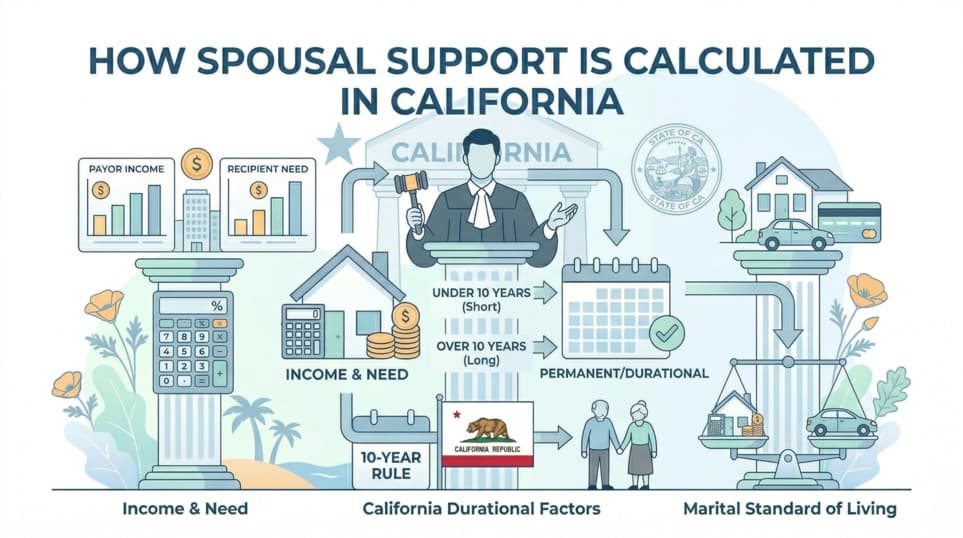
California draws a meaningful line at 10 years of marriage.
For marriages under 10 years, the general guideline is that support lasts for half the length of the marriage. A 6-year marriage would typically produce a 3-year support award.
For marriages 10 years or longer, the court retains jurisdiction indefinitely. There is no automatic end date. The judge does not have to set a termination date; they can leave the order open-ended and revisit it based on circumstances.
This doesn't mean support lasts forever in every long marriage. Courts still expect the supported spouse to work toward self-sufficiency. But it does mean the supported spouse has significantly more leverage in a long marriage than in a short one.
Community Property and Support
California is a community property state. All assets and income earned during the marriage are generally owned 50/50. This is a separate calculation from spousal support, but they interact.
A spouse who receives a substantial share of community assets (for example, keeping a fully paid-off house) may receive lower support as a result. Courts look at the overall financial picture.
When Does Support End?
California spousal support typically ends when:
- The agreed or court-ordered termination date arrives
- The recipient remarries
- Either spouse dies
- The court determines the supported spouse has become self-sufficient
For marriages under 10 years with a set end date, termination is automatic. For longer marriages, the paying spouse must typically return to court to modify or terminate support. It does not end on its own.
What About Stock Options and Business Ownership?
California has specific rules about complex assets:
Stock options and RSUs granted during the marriage are community property to the extent they were earned during the marriage. Valuing them correctly requires a financial specialist.
Business ownership by either spouse introduces significant complexity. Business income can appear lower than actual cash flow if personal expenses are run through the business. Courts frequently order forensic accounting in these cases.
If either of these applies to your situation, you need an attorney and likely a CDFA (Certified Divorce Financial Analyst) in addition to the formula-based estimates this article provides.
Want to See Your Personalized California Estimate?
The formula above gives you the framework, but your actual numbers depend on your specific net incomes, your marriage length, and the adjustment factors that apply to you.
IncoVoid calculates your personalized spousal support estimate using California's guideline formula, including duration, and shows you a full range if you're estimating your spouse's income. It also flags if your marriage qualifies for open-ended jurisdiction.
Start your free IncoVoid assessment →
The assessment takes 12–18 minutes. Your report shows the full calculation with your numbers, not just a ballpark.
Want to see your personalized settlement estimates?
IncoVoid calculates your spousal support, property division, and career impact using your state's specific formulas. Takes 12–18 minutes.
Start free assessment →$299 · 14 pages · Your state's laws