How is Property Divided in a Texas Divorce?
Texas is a community property state, which means most assets acquired during the marriage are split equally. But there are important exceptions — and the courts have more flexibility than most people realize.
By IncoVoid Editorial Team
Texas is one of nine community property states in the US, which means the rules for dividing assets in a divorce are fundamentally different from most of the country. Understanding how this works, and where the exceptions are, can make a significant difference in your outcome.
The Basic Rule: Community Property
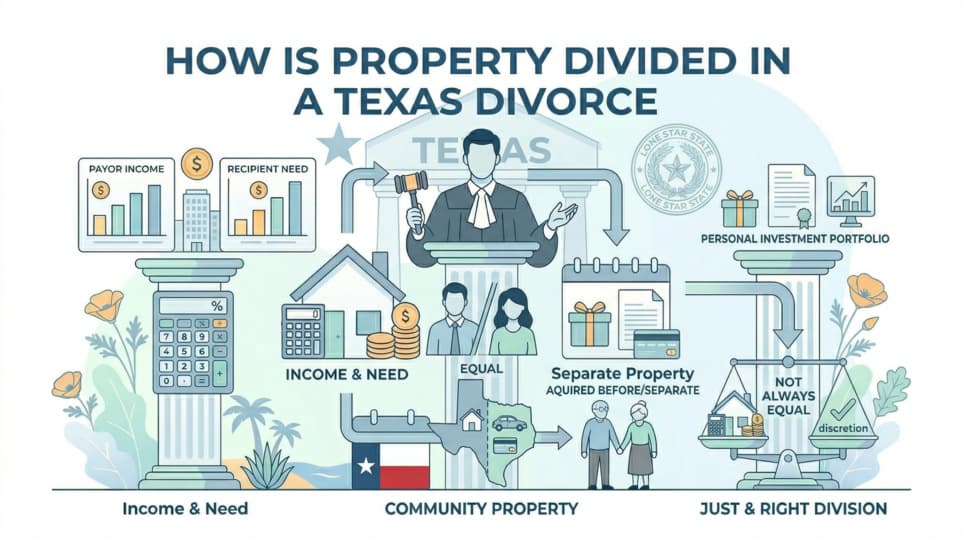
Under Texas law (Texas Family Code §3.002), all property acquired by either spouse during the marriage is presumed to be community property, owned equally by both spouses, 50/50.
This includes:
- Wages and salary earned by either spouse during the marriage
- Real estate purchased during the marriage
- Vehicles bought during the marriage
- Retirement account contributions made during the marriage
- Savings and investment accounts funded during the marriage
- Business interests acquired or grown during the marriage
The presumption is powerful. If property exists and you can't prove it's separate, a Texas court will treat it as community property subject to equal division.
What Is Separate Property?
Separate property belongs to one spouse alone and is not subject to division. Texas recognizes three categories:
- Property owned before the marriage: anything you had before you said "I do"
- Gifts received during the marriage, even if given by your spouse
- Inheritances: money or property left to you, regardless of when it arrived
The key word is tracing. You must be able to prove that separate property stayed separate, meaning it was not commingled with marital funds. If your inheritance went into a joint account that was used for household expenses, tracing it back becomes legally difficult and expensive.
"Just and Right" — The Texas Standard
Here's where Texas surprises people: despite being a community property state, Texas does not require a strict 50/50 split.
Texas Family Code §7.001 says the court shall divide the marital estate in a manner that is "just and right," having due regard for the rights of each party and any children. This gives judges meaningful discretion.
Factors that can tilt the division away from 50/50 include:
- Fault in the breakup of the marriage: adultery or cruelty can reduce the at-fault spouse's share
- Disparity in earning capacity: if one spouse earns significantly more, the lower earner may receive more
- Health and physical condition of each spouse
- Age of both parties
- Who has custody of the children: the custodial parent may receive more, particularly the family home
- Waste of community assets: if one spouse dissipated marital funds through gambling, substance abuse, or hidden spending
- Business interests: ownership stakes that are difficult to divide
In practice, most Texas divorces result in something close to 50/50. But if there's fault, significant disparity, or complex assets, the division can shift meaningfully.
The Homestead
Texas has some of the strongest homestead protections in the country. If you have children and you are the custodial parent, you generally have the right to remain in the family home until the youngest child turns 18. The non-custodial parent's equity is protected but access to it is delayed.
This does not mean you keep the house permanently. It means the sale can be deferred. This is an important planning consideration if you have children and significant home equity.
Retirement Accounts
Retirement contributions made during the marriage are community property, regardless of whose name is on the account.
Dividing a 401(k) or pension requires a Qualified Domestic Relations Order (QDRO), a separate legal document that instructs the plan administrator to divide the account. Without a QDRO, you cannot divide a retirement account in divorce, even if your settlement agreement says you should receive half.
Texas courts also handle pensions carefully. A defined benefit pension earned partly before and partly during the marriage requires an actuarial calculation to determine the marital portion. This is one of the more technically complex areas of Texas divorce.
Business Ownership
If either spouse owns or co-owns a business, the community interest in that business (the portion earned or grown during the marriage) is subject to division.
Valuing a business in divorce is one of the most contested issues in Texas family law. Courts typically require a formal business appraisal. Business owners frequently understate income through legitimate business deductions, which is why forensic accounting is common in high-asset Texas divorces.
What About Debt?
Community debt (debt taken on during the marriage for the benefit of the marriage) is also subject to division. This includes:
- Joint credit card balances
- Mortgages on marital property
- Personal loans taken during the marriage
- Tax debt from joint returns
Important: even if a divorce decree assigns a debt to your spouse, your creditor is not bound by that agreement. If your name is on the account, you remain liable. Refinancing joint debt out of your name is the only true protection.
Want to See Your Texas Property Estimate?
Texas property division depends on your specific asset profile, whether either spouse is at fault, income disparity, and custody arrangements.
IncoVoid calculates your estimated property share using Texas community property rules and the "just and right" factors, giving you a personalized range based on your situation.
Start your free IncoVoid assessment →
The assessment takes 12–18 minutes. Your report includes an itemized asset table, your estimated share percentage, and a full methodology explanation.
Want to see your personalized settlement estimates?
IncoVoid calculates your spousal support, property division, and career impact using your state's specific formulas. Takes 12–18 minutes.
Start free assessment →$299 · 14 pages · Your state's laws