How to Prepare Financially Before Your First Divorce Attorney Meeting
Walking into an attorney's office unprepared costs you hundreds of dollars in billable time. Here's exactly what to gather and know before that first meeting.
By IncoVoid Editorial Team
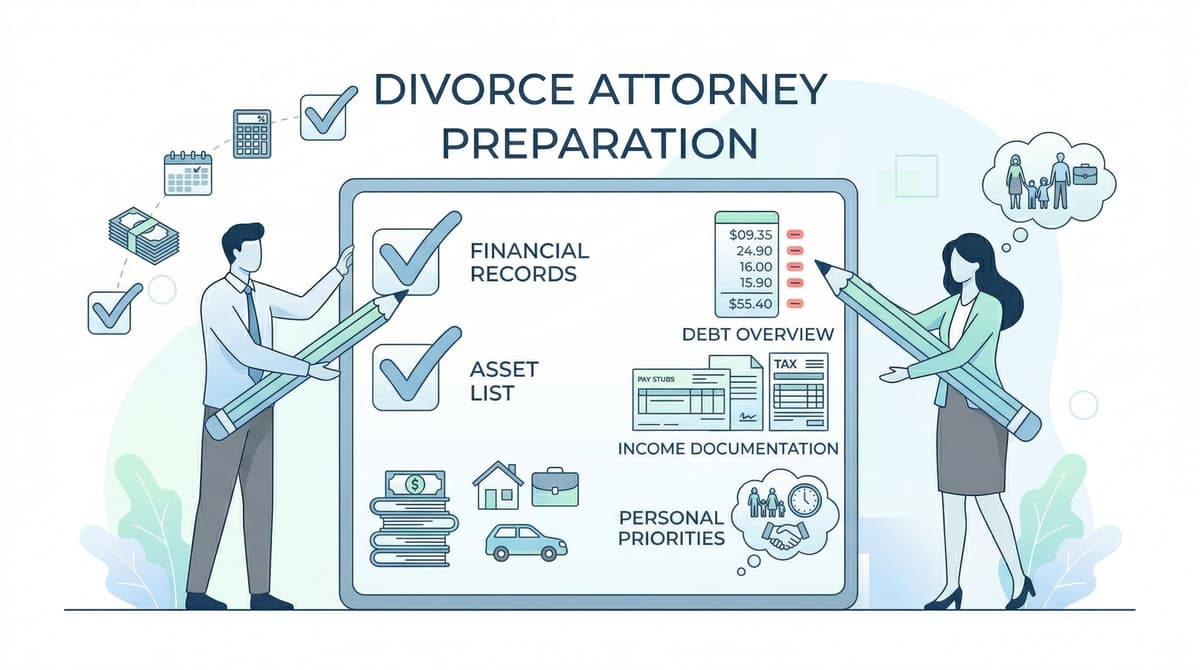
Divorce attorneys typically bill between $250 and $500 per hour, sometimes more in major cities. Every minute you spend with them explaining your financial situation from scratch is money you're paying for something you could have prepared in advance.
The attorneys who provide the most value in that first meeting are the ones who walk in already knowing their numbers. Here's exactly how to get there.
Why Preparation Saves Real Money
Most people walk into their first attorney meeting stressed and underprepared. They know their situation emotionally but haven't organized the financial picture. So the first hour, often billed at full rate, becomes an intake session rather than strategic advice.
Prepared clients get strategic advice from minute one. They leave with an action plan, not just a list of documents to gather. Over the course of a divorce, that difference can be worth thousands of dollars.
Preparation also makes you a better negotiator. When you know your numbers (your likely support range, your share of assets, your post-divorce income picture) you can evaluate whether a proposed settlement is reasonable or not. Without that foundation, you're negotiating blind.
Documents to Gather Before the Meeting
Start collecting these as soon as you decide you need an attorney. Many of them you can pull together in a few hours.
Income documentation
- Your last 3 years of federal tax returns (joint and individual if you filed separately)
- Recent pay stubs — at least the last 3 months
- Any 1099s, K-1s, or self-employment income records
- Documentation of bonuses, stock compensation, or irregular income
Bank and investment accounts
- 3–6 months of statements for every account: checking, savings, money market
- Investment account statements (brokerage, mutual funds)
- Any recent large deposits or withdrawals (these attract scrutiny, so know your explanation)
Retirement accounts
- Most recent statements for 401(k), 403(b), IRA, pension, or any other retirement account
- Note the balance as of the date of marriage if you have it, as this is your separate property baseline
Real estate
- Most recent mortgage statement showing balance and payment
- A rough estimate of current market value (a Zillow estimate is fine as a starting point)
- The deed, if you have it
Debts
- Recent statements for every debt: credit cards, car loans, personal loans, student loans, HELOCs
- Note which debts are in whose name
Business interests (if applicable)
- If either spouse owns a business, any partnership agreements, operating agreements, or recent tax filings for that business
- Even a rough sense of revenue and profit is useful
Other assets
- Vehicle values (KBB or similar)
- Any significant personal property: art, jewelry, collectibles
- Life insurance policies with cash value
You don't need to have all of this perfectly organized. Even having it in a folder, whether scanned or physical, is dramatically better than having nothing.
Know These Numbers Before You Walk In
Beyond documents, know these key figures off the top of your head:
- Your gross annual income (before taxes)
- Your spouse's estimated gross annual income (or your best guess)
- How long you've been married (to the month, if possible)
- Whether you have children and who will primarily care for them
- Roughly what your marital assets are worth, combined ballpark figure
- What your biggest debts are
If you know your state uses a formula for spousal support (many do), have a rough sense of what that formula produces. This is exactly what IncoVoid calculates for you before you ever talk to an attorney.
Questions to Ask Your Attorney
You're interviewing them as much as they're assessing your case. Good questions to ask:
- What is your experience with cases like mine in this jurisdiction?
- What are the most important factors that will affect my outcome?
- What is your estimate of the total cost of this divorce?
- How do you bill — hourly, flat fee, or a combination?
- What decisions do I need to make, and when?
- What should I not do between now and when we file?
- Is mediation or collaborative divorce a realistic option in my situation?
- What's the best-case, worst-case, and most likely outcome for the main issues?
That last question is important. A good attorney won't promise you anything, but they should be able to give you a realistic range based on your facts.
How to Use Your Attorney's Time Efficiently
Once you're in the meeting:
- Lead with facts, not emotions. The emotional processing is important, but save it for your therapist, not your attorney. Every minute on feelings costs the same as every minute on strategy.
- Have a short written summary. A one-page summary of the basic facts (length of marriage, children, income estimates, major assets) lets the attorney absorb information faster than conversation.
- Ask for priorities. What are the two or three things that matter most in your case? What should you be focused on?
- Clarify next steps before you leave. Who does what, by when. Don't leave in a fog.
What Attorneys Are Seeing for the First Time
Your attorney doesn't know your financial situation when you walk in. The more clearly you can paint that picture, with numbers rather than just narrative, the faster they can get to the part where their expertise is actually useful: strategy, legal options, and protecting your interests.
Think of it this way: you're not hiring them to add up your bank accounts. You're hiring them to advise you on how to navigate a complex legal process. The more prepared you are on the financial side, the more of their expertise you actually get to use.
How IncoVoid Helps You Walk In Ready
Before your first attorney meeting, IncoVoid runs your complete financial picture through your state's divorce formulas: spousal support, property division, child support, and career impact. The result is a 14-page personalized report that gives you your estimated numbers before you spend a dollar on legal fees.
You'll walk in knowing what your support range looks like, what a reasonable property split might be, and how a judge would likely view your financial situation, all calculated from your state's specific laws.
Start your free IncoVoid assessment →
The assessment takes 12–18 minutes. The report is $299. If it saves you even one hour of attorney time, it's already paid for itself.
Want to see your personalized settlement estimates?
IncoVoid calculates your spousal support, property division, and career impact using your state's specific formulas. Takes 12–18 minutes.
Start free assessment →$299 · 14 pages · Your state's laws